Ahead of a special appearance in Vancouver, celebrated nature writer Robert Macfarlane makes the case for approaching rivers as living beings.
BY: Ian Gill 30 May 2025 The Tyee
“The best definition of a river I’ve been able to conjure up in my own mind is a gathering that seeks the sea,” Robert Macfarlane tells me near the end of an interview this spring. “Rivers always gather, their tributaries flow together, they have many sources and to think like a river is to think in watershed terms. And that to me is a beautiful unit of organization and responsibility.” It is a thought that encapsulates much of what Macfarlane, a celebrated British nature writer and professor, succeeds in doing in shimmering, aqueous prose in his beguiling, often thrilling new book, Is a River Alive?, which Random House Canada published this month.
Macfarlane challenges us not just to think of rivers as living beings, but to equate their intelligence, their needs and their fears with our own. He invites us to put their thinking on par with ours, and, more than that, perhaps allow that rivers are a lot better at thinking and organizing and taking responsibility for themselves than we humans are.
If we truly thought like a river and behaved like one, in Macfarlane’s formulation the world would be a vastly happier and safer place. In less skilled and less serious hands, this might come across as magical thinking. But Macfarlane, a fellow of Emmanuel College and a professor of literature and environmental humanities at the University of Cambridge, is not just a dreamer but a doer.
What he does in his book and elsewhere in his life is team up with and champion activists around the world who argue for the rights of nature, who seek to give personhood and legal standing to rivers and whole ecosystems.
In doing so, they’re enabling the engagement of constitutional and legal tools in defense of natural systems from their most voracious predators: us.
A storied fight for ‘rivers’ rights’
In the half century or so since the idea of the rights of nature was first mooted, “‘River rights’ have become the commonest form of novel legal subjectivity in dozens of countries around the world, from Australia to Colombia, Canada to Bolivia,” Macfarlane writes.
In 2017, New Zealand went so far as to legislate that the Whanganui River, “from the mountains to the sea, incorporating all its physical and metaphysical elements” is a “‘legal person,’ with the capacity to represent itself in court and to bear rights — the right to flow unpolluted and undammed to the sea, for example, and the right to flourish.”
A decade earlier, Ecuador had stunned the world with the passage of a new constitution that embedded four Rights of Nature articles granting Pacha Mama (Mother Earth) “the right to integral respect for its existence and for the maintenance and regeneration of its life cycles, structure, functions and evolutionary processes.”
One of those articles obliged the state to restrict activities that would harm nature. Ecuador’s audacious declaration became the font for nature rights movements around the world, including New Zealand’s embrace of the Whanganui River as, in effect, a citizen.
So it makes sense that Macfarlane, after a brief meditation on the source of the River Cam near his home in Cambridge, leads readers into a cloud-forest called Los Cedros, the “Forest of the Cedars,” home to the headwaters of the Río Los Cedros in northern Ecuador.
It is one of three waterscapes that Macfarlane journeys to in the course of the book, the others being Chennai in south-east India, and Canada’s Mutehekau Shipu, or Magpie River, in the interior of Nitassinan (Quebec), homeland of the Innu people.
In Los Cedros, we are quickly immersed in Macfarlane’s love language for rivers, and for nature more generally.
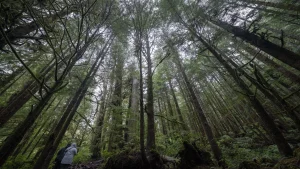
“Much as a bearded person walking through the mist will find water droplets condensing upon the hairs of their beard as well as their skin, so the epiphytes of a cloud-forest act as collectors for the moisture suspended in the mist… To be inside a cloud-forest is what I imagine walking through damp moss might be like if you had been miniaturized,” Macfarlane writes.
“Los Cedros is a living Wunderkammer. It is the home of fabulous beasts, birds, plants and fungi who could have flown, crawled and grown straight out of Hieronymus Bosch’s imagination: the spiny pocket mouse, the strangler fig, the white-headed capuchin, the devil’s fingers fungus, the spectacled bear, the dwarf squirrel, the river otter, the jaguarini, the golden-headed quetzal, the black-and-chestnut eagle” and much more.
Macfarlane has travelled to Los Cedros with Cosmo Sheldrake, a multi-instrumentalist English musician and composer, son of parapsychologist Rupert Sheldrake and the brother of mycologist Merlin Sheldrake, none of them strangers to British Columbia’s forests and rivers. (Macfarlane is bringing his book to a Vancouver Writers Fest event on June 18 in Vancouver; the brothers Sheldrake are featured presenters at a five-day retreat at Hollyhock Leadership Institute on Cortes Island called Science, Art, Sound and the Sacred starting July 30).
In Ecuador, Macfarlane and Sheldrake travel high into the mountains on foot to experience the ecological richness of the forests first-hand. They are joined by César Rodríguez-Garavito, a Colombian lawyer for whom “no distinction is to be made between human rights and the rights of nature.” And there’s Giuliana Furci, a mycologist, biologist, campaigner and filmmaker who is the scientific lead on their expedition.
They, and other activists they meet on their trek, maintain a constant vigil over the cloud-forest, knowing all too well that where precious metals are to be found, mining companies hover like buzzards, ready to swoop on any shift in political power, or perhaps a hostile court ruling that might circumvent the constitutional protections conferred on nature.
Their fears are justified. In 2017 it was discovered that a mining concession had been granted by the Ecuadorian government in the Los Cedros forest, and a permit to prospect the concession had been sold to Cornerstone Capital Resources, a Canadian “prospect generator” that arrived with drills, maps and helicopters to begin surveying Los Cedros.
“They came to kill the forest and its waters — and it seemed as if nothing could stop them,” writes Macfarlane.
But in 2021, in the Constitutional Court in Quito, a “protective forcefield,” was wrapped around the forest when the miners were ordered to leave and make good any damage they had done. One of the judges said that “the call of life” from Los Cedros “swayed the bench.”
Still, the vigils continue. Nature may be sacred, but it is seldom truly safe.
“I have a strong sense of embattlement: of siege having been methodically laid to this cloud-forest over many years — and of enemies still circling, out there in the darkness,” Macfarlane frets.
After an arduous day’s climb — filthy, fly-bitten, stung by a red fire ant, exhausted — Macfarlane conjures the energy to join his fellow hikers in writing a song.
Macfarlane describes “lyrics jotted into a muddy notebook, Cosmo quickly hearing rhythm and melody, recording samples into his phone, then mixing and editing verses and chorus together — and laying down beneath them an undersong of the cloud-forest’s own voices that he’s gathered with his microphones: cicada creeks, dove coos, the clicky patter of a bat’s echolocating sonar bursts, the wind stirring heavy, leathery leaves. Giuliana murmurs a current of river phrases in Spanish: corre río, fluye río, baja río, corre río — river run, river flow, river fall, river run.”
They call it “Song of the Cedars” and you can listen to it with the knowledge that it’s yet another novel defensive weapon in the fight to keep the cloud-forest whole. Late last year Sheldrake, Macfarlane, Furci and Rodríguez-Garavito petitioned Ecuador’s copyright office to recognize the cloud-forest itself as a co-composer of the song, which is thought to be the first legal attempt to recognize an ecosystem’s moral authorship of a work of art.
“We couldn’t have written it without the forest,” Macfarlane told the Guardian. “The forest wrote it with us.”
Macfarlane readily acknowledges co-authorship of Is a River Alive? too. He credits the rivers who — not that, or which — run through it.
After alighting from the vivid fresco of the Río Los Cedros, it is chastening to arrive in the Bay of Bengal to witness the death throes of Chennai’s Kosasthalaiyar, Cooum and Adyar Rivers, all of which have been poisoned: 55 million litres of effluents and sewage a day passing unfiltered from 6.5 million people will do that.
Guided by Yuvan Aves, a devoted caregiver to Chennai’s ailing waterways, Macfarlane is taken 80 kilometres inland to a lake called Vedanthangal, the oldest waterbird sanctuary in India, “a floating city of birds — an avian Venice.”
But as their bus approaches the sanctuary, it fills with the smell of nail polish courtesy of the nearby Sun Pharma factory that discharges toxins into the sanctuary and, Yuvan says, “poisons local people, ruins crops, kills birds.”
There is a hopeful buoyancy to Macfarlane’s account of the seemingly Sisyphean task being undertaken by Yuvan and other young people who are literally fighting big pharma and trying to resurrect a water culture in a region where humans and their ancestors have lived and thrived by rivers, but “where a severe water amnesia has now taken hold.”
Through multiple acts of mapping and remembering what was, and constant advocacy for what might be, the activists seek what they call “multi-species justice” for their rivers.
But for Macfarlane, doubt seeps in: “what chance do these courageous young people have to change any of this?”
‘Despair is a luxury and hope is a discipline’
In our interview, Macfarlane admits, “I am under no illusions that any remedy is a simple one. I think I have learned that despair is a luxury and hope is a discipline. But the luxury of despair is the one where, you know, what right would I have to sit back and give up on changing anything when there are people like Yuvan, fighting against almost inconceivable ecological and governmental forces? Or Rita Mestokosho, who has lived the life of an activist. [For whom] that is your life, it’s not a hobby, you don’t turn up to it on the weekend.”
That hope, that discipline, that fierce love is what Macfarlane seeks and finds in Rita Mestokosho’s poetry, in which “humans are part land (‘my heart is made of pine branches’) and subject to sudden transformation; to skin-slipping and shape-shifting (‘I will become salmon’).”
“Often in her poems, the rivers, the land and their beings speak,” Macfarlane writes. “Caribou listen to and address the reader. A bear is a grandfather, and wolves are great-uncles. Streams whisper, the sky utters and rivers murmur the name of an Elder who has passed away.”
“‘We all have a river who calls to us,’” Mestokosho writes.
Mestokosho’s river is the Mutehekau Shipu, a river that the corporation Hydro-Québec would love to dam and drown, adding to a “vast electrical machine” that has already dammed 14 of the 16 officially declared “large rivers” in Quebec.
Before attempting a descent of the river by kayak, Macfarlane and his friend Wayne Chambliss stop at the coastal township of Ekuanitshit to pay their respects to Mestokosho, and to pay homage to another form of river-rights activism that staved off the damming of the Mutehekau Shipu — the first river in Canada to be recognized as a living, rights-bearing being.
continued in Part Two