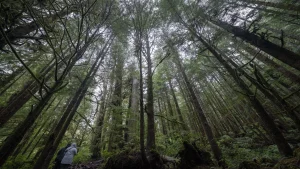
A four-storey, 102-unit rental development is proposed for a forested lot that contains a small wetland..
Julie Chadwick
about 15 hours ago
A resident of Nanaimo’s Rock City neighbourhood in north Nanaimo is speaking out against a development project she says threatens a unique wetland that is a “crown jewel” of the city.
Tamara Brown has lived in the area for about six years and says she has extensively studied both the wetland and the proposed four-storey, 102-unit rental development, which would also have two storeys of parking.
The heavily forested, sloped 1.52-hectare property at 3400 Barrington Rd. was rezoned for medium-density residential use four years ago. The current project was approved by the city in early January, although work has not yet begun.
Critics are concerned that the removal of trees, bedrock blasting and excavation expected during construction would disturb the water flows of a rare ecosystem.
The property is made up of a rocky knoll along Barrington Road and a small wetland along the west property line, with a large wetland immediately to the north.
Brown said she and other residents have observed plants and other features in the wetland that are characteristic of both bogs and fens, which is extremely unusual. Fens are wetlands that accumulate peat and are fed by a surface or groundwater source.
She said the only other comparable ecosystem she knows of is Rithet’s Bog, a protected wetland in Saanich.
“The discovery of this ecosystem and how special it is should be celebrated as an ecological crown jewel of Nanaimo, and instead I find myself having to defend and justify it,” said Brown, who has 20 years of experience in fisheries-related work.
At a council meeting this week in Nanaimo, Brown raised other concerns, including the potential impact on the Garry oak ecosystem and breeding habitat for birds and amphibians.
In her presentation, Brown said any further disturbance of the site should be paused until the wetland has been independently reviewed to determine whether it warrants protection under the province’s riparian areas regulation.
Brown said she had reached out to aquatic biologists across the province, who seemed stumped by her descriptions of the wetland. “Nothing that I was describing sounded like anything they were familiar with,” she said.
In May, ecologists from the B.C. Conservation Data Centre visited the area to classify the wetland. They called it a new kind of peatland not yet tracked by the centre, although it’s expected to be included in their database in 2027.
Currently, it most closely matches a known peatland at risk of extirpation or local extinction, but because it’s not a perfect match, the risks are not yet known, they said.
The area in question includes the small seasonal wetland on the west side of the property that receives storm drainage from two local roads, according to a bio-inventory report completed in 2024 on behalf of the developer.
During the rainy season, that wetland drains into the larger wetland near the northwest corner of the property. The larger wetland is downstream, and is a forested swamp that drains from a small watercourse to form part of the headwaters of the Cottle Creek watershed.
The report notes that the swamp wetland is not fish-bearing. However, it is known that the Cottle Creek watershed it feeds into is fish habitat, home to coastal cutthroat trout.
Brown argues that this is evidence of an interconnected hydrological system, which means it should legally fall under provincial protection.
When a trail was constructed adjacent to the smaller wetland in 2023, small culverts were installed to allow for the surface flow of water, said Jeremy Holm, the city’s director of planning and development. Holm said he’s since been advised that there is no evidence of surface flow.
Environmental professionals who advise the city have said that it doesn’t fit the test of interconnectivity from a riparian-area-protection regulation perspective, he said. Holm said the city approved the project based on the information those professionals provided.
He noted that the city has developed its own framework to protect watercourses that has evolved over time, and is intended to “meet or beat” the province’s riparian-area protection regulations. When it comes to this project, he said he’s confident it meets the requirements.
“In the city’s opinion, it does comply, and that’s the approach and the position that the city’s taken,” he said, adding it seems unlikely there will be delays to the project, at least for environmental reasons. Holm said the city will continue to ensure the project meets design standards and its own regulatory framework as it progresses.
At Monday’s meeting, Coun. Paul Manly questioned Kevin Brydges, the city’s environmental co-ordinator, about the province’s potential designation of the area as a S1 or “critically imperiled” red-listed ecosystem.
“Is that an assessment that you would agree with?” he said.
“Yes, I think it was designated that, right off the bat. It just wasn’t called an S1 designation, that’s something relatively new,” Brydges said. “It is a very rare ecosystem.”
Developer Hyland Properties did not immediately respond to a request for comment.
jchadwick@timescolonist.com