Posted by Ty Lim | Aug 20, 2025 | News, Forestry, Trending | 0
Severe floods like the 2021 atmospheric river event could happen as often as every 20 to 40 years instead of 200 because of the effects of logging, a new study finds.
UBC Professor of Forest Resources Management and researcher Younes Alila says 20-years of his research has proved that B.C.’s dominant forestry practice of clear-cutting has dramatically increased both the intensity and frequency of floods.
“I realized that forest hydrologists internationally have been misguided by a methodology and an experimental design that underestimated a great deal, the effect of the forest and the power of the forest at actually mitigating the flood risk,” Alila said in an interview with the Herald.
His latest study, conducted with support from the US Department of Agriculture and the US Forest Service, looked at the effects of 50 years of data of clearcutting in an experimental watershed in North Carolina, the Coweeta Hydrologic Laboratory.
The study looked at two adjacent watersheds, one north-facing and one south-facing, that were both clearcut in the 1950s. The north side, which received less sunlight, retained more water and the frequency of floods was increased by a magnitude of 18 times.
Alila explained, this was because the area of trees cut in that area removes cover, meaning more snow melts into the ground which provides more runoff in the water channels.
Combined with heating effects from global warming, Alila says this impact heightens the extremes of both a lack of flow in the water system and overflow, meaning both floods and droughts are more common.
Alila’s research has been going on for nearly 20 years, he said, advocating for a new model for forestry management that takes into account the impact of floods on the watershed, and also moving away from clearcutting practices.
“At the university and the faculty of forestry, we teach the undergrad and graduate students different ways of logging, and clear cut logging is only one of them. It is the preferred way of logging by the industry and the government of B.C., because it’s the cheapest way to get their wood,” he said.
Before the 2000’s, clearcutting was widely used in B.C., removing millions of hectares in land every year. Since 1999, clearcutting numbers have dropped, mostly due to B.C. running out of harvestable trees.
Clearcutting still remains one of the go-to ways for forestry though, with clearcutting with reserves – a system which leaves a small batch of trees for future growth still standing – being one of the primary ways B.C. has logged its forests.
He said watersheds were extensively logged as well.
“We have excessively clear-cut-logged across watersheds of all sizes, the small, the medium, the very large watersheds, they’re all excessively logged,” he said. “You just have to fly using Google Earth over anywhere in B.C. and elsewhere in Canada [and you can see].”
Because of the amount of forest logged, Alila said his methodology can be used in predicting the frequency of floods in B.C. too.
“What clear-cutting does, it increases the severity of the floods, the runoff in the channel, it increases the frequency with which these flood levels are reached, but also it increases the duration of the floods,” he said. “The forest cover is protecting you against nine of the 100 years (of flooding). You remove the forest, you’re going to see your watershed is going to experience these events once every 10 years, as opposed to only one every 100 years.”
For the Nicola Valley, Alila said that this means the one-in-two-hundred year event would be 10 times more common.
“When you hear in the news or out of a government agency, that the November 2021 (flood) was a once-in-100 year or 200-year (event), that’s based on the the historic record of flows, and that historic record of laws is no more representative of the current flood regime and future flood regime,” he said.
“Because you develop the watershed by mining, by urbanization, you disturb it by wildfire, by forestry activities, you change the way the hydrology responds, the way the landscape responds.”
From 2001 to 2024, Global Forest Watch states that the Thompson-Nicola region has lost over one-million hectares of tree cover. Of that tree cover with greater than a 30 per cent canopy, the losses are split almost evenly between the forestry industry and to wildfires at 54 and 44 per cent respectively.
Global Forest Watch states that there are 3 million hectares of forested land cover left in the Thompson-Nicola region.
The B.C. government states that 80 per cent of tree-harvested areas are reforested by tree planting. Even with this effort, Alila said there are still consequences, mainly because the coniferous trees take up to 60 to 100 years to grow back to the size needed to regain their use to the watershed.
Alila advocates for the government to adopt and promote different logging methods that cut the time to re-grow an area by 20 to 40 years. These methods are selective logging, strip logging and small patch logging.
“We actually can gain 20, 30, 40 years of regrowth, because we’re not abandoning the small and medium were not taken off along the way.”

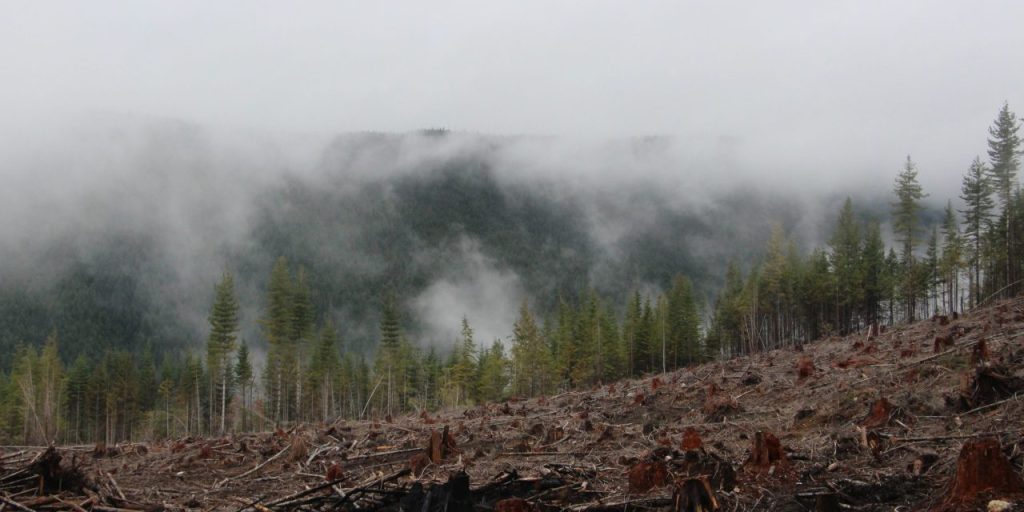
UBC study says clearcutting raises risk of 100-year floods. Photo/Contributed
This research paper is Alila’s newest in a 20-year-long career shedding a light on the issue.
Last month, CBC reported that the government is aware of Alila’s research, saying it is one of many pieces that will help them form a sustainable forestry sector.
But Alila said he’s seen the same response with his other research papers, and doubts the government will change their policies on their own.
“I have to point out that there are other ways of logging the forest that will cause much less effect, and we need to adapt the alternative logging practices. The only way to do that is the political will. Basically, there is no political will. The buck stops at the government period.”
Alila said the one “beacon of hope” for the watershed is the role of First Nations governance in having a say on logging.
“The Indigenous culture and the Indigenous experience for 1000s of years and the Indigenous knowledge is very well aligned by this new paradigm of forest hydrology that is now establishing the fact that the forest cover is one of our major natural asset in protecting the downstream community,” he said.
“The stakes are so high. And basically the forest brings so many values, not just the timber value, not just the value of the wood, it brings so many values. It protects biodiversity, and water is at the top of those values. And I think it’s about time we manage the forest for what it is, for biodiversity. We manage forests for what mother nature has created it for, wildlife, for all the biodiversity, for water, for tourism, for so many values, but we’ve just been managing the forest with only one value, and that’s the value of the wood, the timber.”