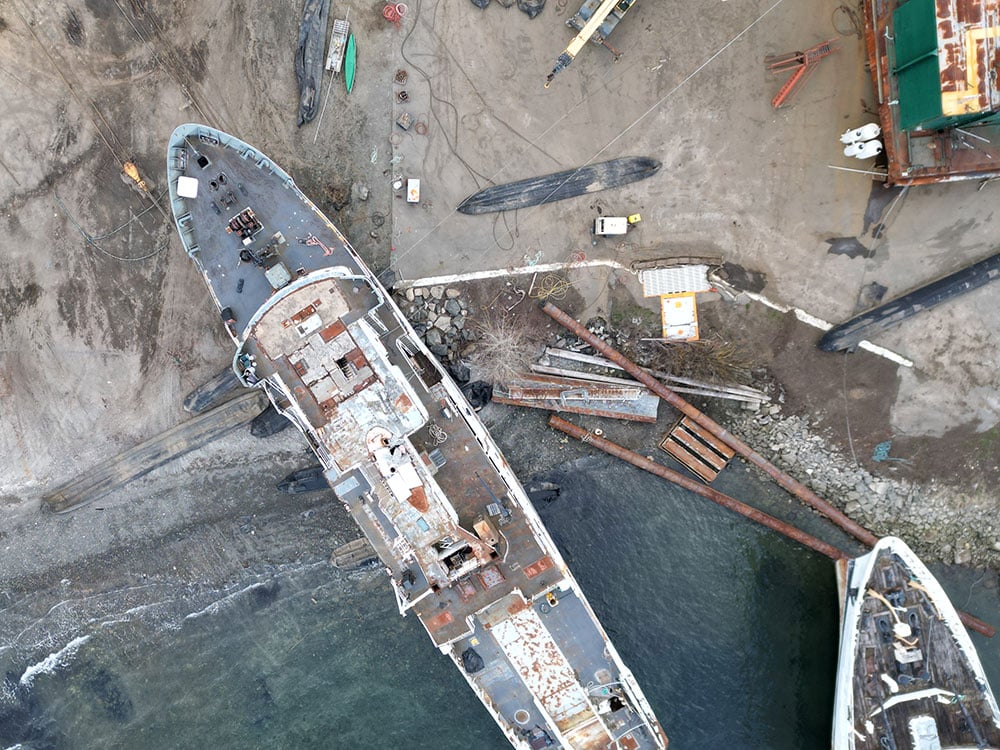
Deep Water Recovery defies eviction in Union Bay.
by Zoe Blunt
Last year, observers on Vancouver Island were celebrating a provincial decision to cancel a shipbreaking company’s foreshore lease in Union Bay.
As Watershed Sentinel reported at the time, (“In the Public Interest,” October-November 2025), the cancelled lease
came after years of documented environmental damage, official warnings, and fines levied against shipbreaking company Deep Water Recovery Ltd. The cancellation was hailed as the beginning of the end of the toxic shipbreaking industry in the abundant waters of Baynes Sound.
A year later, no one is cheering. It appears that DWR, a US-owned industrial waste handler, is choosing to defy the ruling and
carry on as before. The provincial order gave DWR 60 days to vacate the property, but aerial drone footage released by Concerned Citizens of Baynes Sound in September 2026 shows no sign of cleanup or decommissioning. Two ships are
anchored in the bay, one partially dismantled, and piles of rusty metal and garbage cover the property. Workers can be seen
maneuvering loaders around the piles. Baynes Sound, a sheltered piece of the Pacific Ocean 100 km north of Nanaimo,
is home to shorebirds, herring, and BC’s
largest shellfish harvesting hub. These are the waters and the food chains that DWR is illegally polluting with lead, asbestos,
mercury, and oil, according to an August statement from the K’omoks First Nation. Last year, the Province levied $72,000 in fines against DWR and demanded a $3.2 million security deposit to guarantee cleanup of the site. It is not clear if either has been paid.
“These fines don’t go far enough,” said K’ómoks First Nation Chief Councillor Nicole Rempel. “Shipbreaking has been
contaminating Baynes Sound for six years and nothing has changed.”
In August 2022, Ministry of Environment staff visited the DWR property and reported “wood debris, steel scrap, unusable rusted material, septic system discharge, recreational vehicle effluent, and surface water effluent.” Ministry staff confirmed that DWR had no treatment systems connected to its sumps, which are designed to discharge directly into the marine environment when full.
K’omoks First Nation has been working with local and provincial regulatory bodies to stop the contamination for six years, with no results. “We’re calling on the federal government to step up, to finally stop these heavy metals and chemical toxins from leaching into this delicate ecosystem,” Rempel said. “Fifty per cent of BC’sshellfish are harvested here. No one wants more lead and copper in their food.”
The region’s MP, Gord Johns, has so far tabled two private member’s motions calling on the government to establish enforceable standards in the ship recycling industry (similar to those in the EU). The
first, tabled in 2022, got lost in parliamentary changes and dissolutions; the second, tabled in May 2025, is still waiting
its turn to be debated. Meanwhile the industry operates in a regulatory grey zone, taking advantage of limited enforcement
and significant gaps between federal, provincial, and municipal regulations.
The KFN statement condemned the Province’s “toothless” environmental policies and noted that the recent fines are “the
cost of doing business” rather than a true deterrent to stop DWR’s unsafe shipbreaking practices.
In 2026, the Comox Valley Regional District renewed its 2022 BC Supreme Court action seeking to permanently shut down
the shipbreaking site in Union Bay. The Province controls foreshore leases while the Comox Valley Regional District has
jurisdiction over DWR’s upland operations.
https://watershedsentinel.ca/wp-content/uploads/2026/11/WSDec26Jan27.pdf