
EDITOR’S NOTE: I believe the concrete pipes that re being referred to in this article are in fact “concrete asbestos” pipes.
We have asked questions about these pipes, but we continue to be told to not worry about them.
From concrete pipes that can catastrophically fail to holes in the South Fork dam that could empty the reservoir within days, here’s how the City of Nanaimo is working to reduce the risk to residents.
By Mick Sweetman ● Nanaimo ● May 20, 2026
The South Fork Dam has supplied Nanaimo with its drinking water since 1931 and is in need of repairs to plug leaking culverts and a new water supply pipe to replace the one that has been in continuous operation for almost 100 years. Photo courtesy of the City of Nanaimo.
The next time you pour yourself a glass of water, boil a pot of water for cooking, or step into the shower imagine that no water came out of the tap when you turned it.
Every moment you open the tap, you are relying on roughly 700 kilometres of pipe maintained by city staff to get you the clean water you rely on.
The city’s engineering and public works 2025 business plan estimates that about six per cent of the pipes are near the end of their useful life and require “heightened monitoring and eventual replacement.”
With high profile water main breaks in Calgary and Montreal, the City of Nanaimo is working to get ahead on critical infrastructure replacements for a known offender: concrete pressure pipe.
“It’s a very catastrophic pipe. When it does rupture, it can cause significant damage,” Mike Squire, the city’s manager for water resources, told the city council’s governance and priorities committee on May 11.
Squire presented a five-year capital plan to Nanaimo City Council that could prevent a “catastrophic failure” of critical water supply infrastructure.
A major watermain break in the city could blow out large sections of pipe that quickly drain reservoirs and interrupts water supply for both residents and firefighting, Squire told The Discourse.
If just one of three leaking 24-inch culverts in the South Fork Dam fully breach it could drain the city’s water supply within days, leaving residents and fire services dependent on limited untreated water pumped in from Harmac Pacific that would put the entire city on a boil-water advisory with strict water restrictions.
Squire said that the city is in good shape to address the risks that have been identified and a plan is in place to ensure that Nanaimo has enough clean water to quench the thirst of residents as the population and industry grow over the next 20 years.
“We’re trying to build a resilient water supply system, so if any of these events — whether it be climate change, an earthquake, or a [water main] break — [happen] the city has ways and means to convey water fully to the community, so we won’t be in a position where the city is out of water,” he told The Discourse.
Nanaimo’s past experience with water main breaks
In April 2020, the water main on Bowen Road suffered a major break draining three reservoirs and leaving the Nanaimo Regional General Hospital without running water.
“I don’t believe this community can afford the hospital to be out of water,” Squire said recalling the 2020 break.
The spill of 22 million litres of water caused an estimated $250,000 in damages to local homes.
The type of pipe used for that water main and others in the city are constructed out of concrete and when they break the result can be catastrophic.
Similar pipes in Calgary suffered major breaks in 2024 and again earlier this year. Last week, a water main break in Kamloops left 8,000 households without water for 36 hours.
A major barrier for the City of Kamloops getting information about the water main break out to residents was that people had not signed up for its free emergency alert system, known as Voyent Alert.
Evan Lloyd, emergency manager at the City of Nanaimo, said that people should sign up for the Voyent Alert System, which provides local emergency alerts from the city as well as the Regional District of Nanaimo.
In response to the water main break on Bowen Road, the city undertook a major upgrade to the midtown water supply system that was completed in 2024.
The work included laying both a new primary transmission watermain that delivers water from the College Drive reservoirs to the Labieux Road water station. It also included a new secondary transmission watermain from College Drive to Bowen Road and Pryde Avenue. It also built a dedicated supply main for the Nanaimo Regional General Hospital.
Squire told the committee that the work on the midtown water supply means that the Vanderneuk reservoir and Rutherford Road supply main projects in North Nanaimo can be deferred to address more critical issues in South Nanaimo.
Emergency response in the event of a major water main break
In the event of a major incident in Nanaimo, the city’s emergency operation centre will be activated helping coordinate the response by different city departments as well as provincial and federal authorities.
Lloyd told The Discourse that the city maintains emergency management capability at all times and is ready to respond to a wide range of emergencies from disruption of the water supply, to wildfires and major earthquakes.
What the response could look like for a disruption of the water supply would depend on the nature of it and how long it could last, but would involve support from the province.
Lloyd said that his department would look at the responses from previous incidents in other communities, such as Calgary, to learn lessons and best practices.
The emergency management operations centre would bring the experts from different areas responding to a situation together to make decisions “that are as agile and knowledgeable as we can,” Lloyd said.
Lloyd said that before the South Fork Water Treatment plant was completed in 2007, boil water advisories in the city were more common and that the high-tech facility plus Nanaimo’s large water supply gives the city a “strong resilience.”
Lloyd suggests that residents be prepared to shelter in place for several days and also be ready to evacuate if needed with an emergency kit prepared with at least seven days worth of supplies in the event of an emergency.
Concrete pipe along above Nanaimo parkway slated for replacement
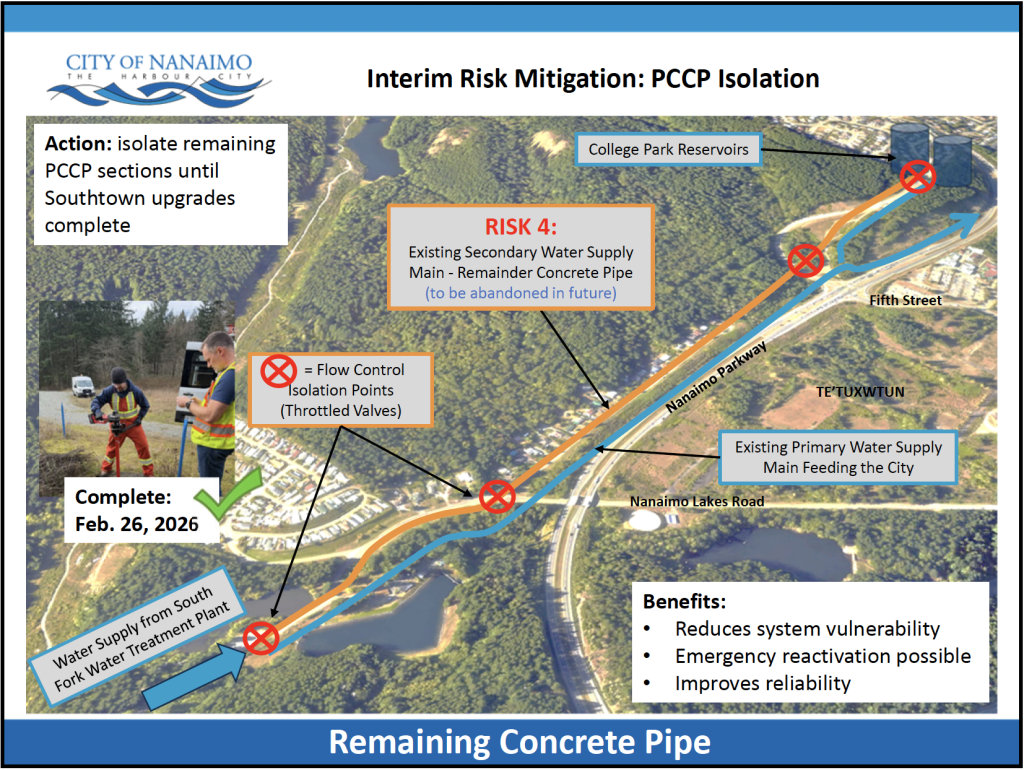
Squire told council that the secondary water supply main coming into the city from the College Park reservoirs on Dogwood Road above the Nanaimo Parkway is constructed with the same type of concrete pipe that failed on Bowen Road.
In response to the risk of a water main break along the parkway, the city has throttled the valves along the pipe to isolate the sections.
“So if it does break, or pardon me, when it breaks, it will be a flow equivalent of a fire hydrant being open” Squire said, estimating that it will take five years to replace the pipe.
There is also a bottleneck of water supply in the south end where demand for water is projected to exceed capacity within five years.
The city would like to replace the existing connections off the main supply line with a parallel distribution main that will support new developments including the te’tuxwtun property on the former site of the Nanaimo Indian Hospital that was added to the Snuneymuxw First Nation’s reserve lands last year.
The project is estimated to cost more than $40 million and will be complete by 2032.

It is almost certainly asbestos cement water pipe. Nanaimo has 90 km of old asbestos cement water pipes. Several past municipal reports point to the high breakage rate of asbestos cement water pipes. The report in the article talks about the high breakage rate of asbestos cement water pipes. The question is why are they referred to as concrete pressure pipes in the news article? Shouldn’t residents have the right to know if we are talking about the possibility of drinking asbestos? It seems odd to call them pressurized concrete water pipes.
Thank you for pointing this out.