Continued from Part Two…
Managed Forest is a BC Assessment property classification established in 1988 to encourage private landowners to manage their lands for long-term forest production on lots of 25 or more hectares. Stewardship plans for these lots are supposed to guarantee protection of key public environmental values, including soil conservation, water quality, fish habitat, critical wildlife habitat and reforestation. In return, landowners get property values assessed at a lower taxation rate, and they are assured the right to harvest trees unrestricted by local government bylaws. There is nothing to require landowners to be in the program, though, or to stay in it if they wish to withdraw.
According to the Ministry of Forests, Lands, Natural Resource Operations and Rural Development, there are 5,125 hectares in 190 parcels of private land registered in the Private Managed Forest Land Program within the Islands Trust area. On Salt Spring, there are 32 parcels totalling approximately 997 hectares of PMFL. The program may pose the biggest challenge to planning on Galiano Island, where roughly half the island or 3,100 hectares was once owned by MacMillan Bloedel. Today, around 1,350 hectares are registered as PMFL.
Islands Trust Council unanimously passed a resolution in June to ask for an amendment to the PMFL Act that would require those landowners to uphold the same standards Crown land loggers are held to, and to give local governments the power to regulate activity on privately managed forest lands. Similar motions were endorsed by the Union of B.C. Municipalities last September. The UBCM has endorsed nine such previous resolutions dating back to 1991.
“Trust Council and other municipalities have approached the provincial government to amend the PMFLA numerous times as there are significant concerns with the legislation,” said Galiano trustee Tahirih Rockafella. “These include the lack of public consultation on stewardship plans, the submitting of management plans only after harvesting and road building has taken place, and the general self-regulating guidelines that do not ensure sustainable forestry and the protection of key environmental values.”
Minister Donaldson declined to be interviewed for this series. A response from the ministry said stakeholder groups were encouraged to provide a formal submission to the PMFL Act review process.
“The provincial government is committed to discussing how provincial legislation and local government jurisdictions can work together more effectively for all British Columbians,” the ministry stated in an email.
Paradigm shift needed
Olsen says his Saanich North and the Islands constituency office has received email representing 22,000 individual concerned citizens regarding B.C.’s forestry practices. People have called for help to stop old-growth logging on public lands and private land clear-cuts, including the 18 hectares on Beddis Road that first galvanized Salt Spring’s community last winter.
Olsen believes the B.C. government has critically failed to move beyond the resource exploitation-based economy of early colonial days. As a result, forest values such as carbon sink use, water purification and oxygen production are not being calculated.
“Forests are viewed as being only for our benefit, and only for their cash value — an asset that only has value if it’s liquidated,” Olsen said.
“The only calculation is for cash value and if the province is generating even a few dollars from that, that’s what we’ve always done as a province, and that’s what we’re going to continue to do.”
Olsen conceded the NDP government has made some recent amendments to the Forest and Range Practices Act. One bill opens up transparency around what is being cut and where logging roads are going to be on Crown land. Another bill makes it more possible to track forestry company tenure sales and transfers of cutting rights. But he categorizes these shifts as mere “window dressing.”
“What’s really disappointing for me is to hear the minister of the government that was so critical of the BC Liberals now basically rolling out the same rhetoric that every forestry minister has rolled out, at a time in which we don’t have the benefit of time that maybe past forestry ministers thought they had,” Olsen said. “We are now being told by scientists and the science community that we’ve got 11 years [before irreversible climate change] . . . We need a complete rethink on how we approach these issues.”
Local naturalist and author Briony Penn also argues the paradigm must shift on how forests are valued. To start with, the forestry industry’s real impact in terms of emissions and the loss of carbon sinks should be determined. Penn further suggests people should be rewarded for protecting forest cover, instead of profiting by cutting it down, only to cause problems whose impact has yet to be tallied.
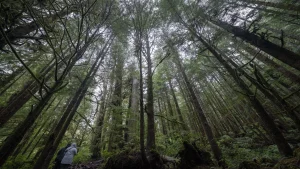
“It’s world view: we haven’t got it in our heads that trees are important to humanity,” Penn said. “If we have trees, we have water; if we have trees, we have air; if we have trees, we are cooling the climate. And I think we’re slowly getting there, but not fast enough.”
https://gulfislandsdriftwood.com/stumped/