Could the oil sands, Canada's greatest economic project, come undone simply because no one thought about water?
http://www.reportonbusiness.com/
servlet/story/RTGAM.20080327.wrob-0408-liquidasset/BNStory/specialROBmagazine/home
Andrew Nikiforuk
Globe and Mail
March 28, 2008
Here in Canada, we tend to think that while water scarcity, drying rivers and toxic lakes may be huge global problems, they really only affect places like China and the Middle East. But the rapid development of Alberta's oil sands, coupled with accelerating population growth and climate change, has turned arid Alberta into Canada's ground zero for water. Our history is all about exploiting our abundance of natural resources, and Alberta is the embodiment of the frontier's boundless promise. Could our tradition of taming the landscape finally have been arrested by something as humble as H20?
The water experts say yes. The Canadian dean of the discipline, the University of Alberta's David Schindler, wrote in 2006 that Alberta, along with Saskatchewan and Manitoba, will soon face "a crisis in water quantity and quality with far-reaching implications." Natural Resources Canada has predicted shortages for Calgary as early as 2050 if conservation efforts don't improve drastically. The federal government's 2007 report on the oil sands concluded that "the Athabasca basin could encounter serious problems unless there is a radical change in water use."
While the energy boom is bringing the issue to a head, Alberta's looming water crisis owes something to natural factors as well as human-made ones. Lying in the shadow of the Rocky Mountains, the province is one of the driest places in Canada, with but 2.2% of the nation's fresh water. It's also prone to long, bone-bleaching droughts. Both historical accounts and tree-ring studies show that European immigrants settled the province during the wettest century in the last 2,000 years. This data also suggests that the dust bowl of the Dirty Thirties was a minor event and that no European has ever seen the kind of 20-year droughts that have characterized Alberta's climate over the millenniums.
In addition, Alberta shares with the rest of the nation a geographic vulnerability. Most of its water is in the north while most of its people live in the south. Albertans are concentrated in the South Saskatchewan River basin, where the city of Calgary, industry and irrigation drink lots of water. Yet the basin and its northern cousin, which drain into Hudson Bay, hold only 20% of the province's supply. Northern rivers such as the Athabasca and the Peace carry about 80% of the province's water into Canada's largest watershed, the Mackenzie River basin, which drains into the Arctic.
Unlike most of the country, however, Alberta has a regulatory system that allocates blue gold on a "first in time and first in right" basis. The system "is designed to deal with shortages," explains John Thompson, an Edmonton-based resource economist and water expert. During periods of scarcity, the rules are clear: Those who hold the oldest licences get the water; the newest ones, as Thompson puts it, must "stand back from the trough."
River basins, of course, need water for fish, birds and wetlands as well as for human uses. Prompted by declining river flows and fish kills, the province dramatically closed the South Saskatchewan River basin two years ago, ruling that no one can put more straws into the river.
The overallocation that led to the closure has been compounded by a paucity of data on surface water and groundwater. A 2008 report by the Alberta Water Council, a non-profit watchdog set up by the province, described "the availability, quality and accessibility of data" as a concern. The alert was echoed by the Petroleum Technology Alliance of Canada, a non-profit research group that regards water as "the environmental issue of the century." In a recent paper, the alliance concluded that "rapidly growing demands for water, where data is limited due to reduced government-supported data-gathering in the last 20 to 40 years, will drive and limit development."
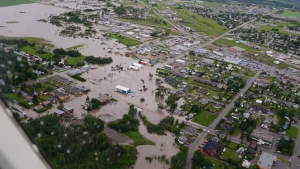
Climate change has also begun to disrupt the province's water budget. A warmer and more extreme climate means less water when you need it most. (It can also mean too much water when you need it least.) Thanks to temperature increases of two to four degrees over the past 30 years, most Rocky Mountain glaciers have lost nearly a third of their mass, while snow packs, the source of most drinking water, have also shrunk. As a consequence, river flows in the summer have declined by 30% to 85%. Schindler predicts that a collision of population growth, drought and climate warming will soon teach "Albertans first-hand what water scarcity is all about." He thinks that rapid oil sands development may well be water's tipping point. While some in the industry agree, many others see shortfalls as another challenging opportunity that calls for technological fixes. "With the pressure on water in northern Alberta, one thing is for sure," says John Robertson, a senior manager with CH2M Hill, the global engineering giant: The industry will have to spend "hundreds of millions in the next few years to treat and reuse water."
In the last 12 years, the world's most powerful oil companies, including Imperial Oil, Shell, ConocoPhillips, British Petroleum, Total and Norway's StatoilHydro, have all rushed to Fort McMurray to plunk down more than $150 billion in the oil sands. The frenzied pace of investment and construction in one of the globe's last proven oil reserves has created a national project even bigger than the transcontinental railway. The oil sands are the world's largest energy project. Nothing in any sector matches it for capital investment.
The rapid approval of more than 50 oil sands projects since 1996 has not only made Canada the No. 1 supplier of oil to the United States but also the world's seventh-largest producer. Prime Minister Stephen Harper has described the oil sands "as an enterprise of epic proportions, akin to the building of the pyramids or China's Great Wall. Only bigger." Economists calculate that the oil sands will contribute nearly $1 trillion to Canada's gross domestic product by 2020.
But the prized resource really isn't oil per se, but bitumen. It's a tarry and dirty mixture of clay, water and hydrocarbons that lies, sometimes shallow and sometimes deep, under a quarter of Alberta's land mass. Extracting this bitumen from the sand takes remarkable volumes of energy and water. Indeed, every phase of production in the oil sands?from the open-pit mines to the refineries in Upgrader Alley?demands a lot of water, and dirties a lot of water too.
Mining bitumen resembles bulldozing mountaintops to excavate coal deposits in Appalachia?except that it's boreal forest that's being removed. A half-dozen city-sized mines now line the banks of the Athabasca River.
On average, the mines consume between three and four barrels of fresh water to produce one barrel of bitumen. Most of the water is heated to separate the hydrocarbons from sand and clay in a process akin to operating a giant washing machine. Although companies such as Syncrude recycle their water as many as 18 times, the industry still procures most of its water from the Athabasca River or from aquifers that feed the river.
The degree of water use directly reflects the quality of ore recovered, says Bruce Peachey, president of New Paradigm Engineering in Edmonton. "We are presently mining the best ores. But as clay content increases, the volume of water needed in production will increase. So this is the good time for water."
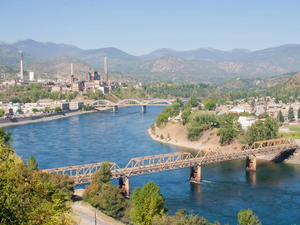
The industry now accounts for more than 76% of the water allocations on the Athabasca River, Alberta's longest undammed waterway. Current licences allow industry to take 3.2 billion barrels of fresh water a year?enough to supply two cities the size of Calgary. Planned expansions could bring the total to 4.2 billion barrels per year, a volume Natural Resources Canada says "would not be sustainable because the Athabasca River does not have sufficient flows."
Although environmental and aboriginal groups have long campaigned for the provincial government to enact a firm water policy for the river, nothing materialized until the province released a scathing report on oil sands development in February, 2007. Written by Doug Radke, the former deputy minister of the environment, the report called the province's ability to enforce environmental regulations "inadequate" and described planning on the cumulative effects of the oil sands as "unclear, outdated and incomplete." Echoing the federal opinion, it also noted that the Athabasca River may not be able to support what's planned.
The next month, Alberta Environment and the federal Department of Fisheries produced an interim plan for the river. The framework, which gives the province two more years to figure out what quantity of water the river really needs to sustain fish, works like a stoplight. Green-light conditions allow industry to withdraw up to 15% of the flow; a yellow light encourages industry to proceed with caution by reducing withdrawals to 10% of flow; and a red light restricts allocations even further. But even during a drought, when the red light is on, industry will get enough water to fill 50 bathtubs per second.
Preston McEachern, the head of oil sands research for Alberta Environment, calls the framework conservative and precautionary. "There is a lot of water in that river…and our numbers [for withdrawals] are low compared to industrialized rivers in Europe or the United States." Still, the caps will challenge companies "to plan their projects with exceptional environmental controls."
Schindler calls the framework "inadequate." But he reckons it's probably as good as the government could do, given the data deficit on the river. He notes that current and approved withdrawals "would already put the river in red-zone conditions for several months in winter during low-flow years."
Moreover, winter and summer flows of the river have declined 30% since 1970, and could drop more than 60% by 2050.
Solutions to the imbalance of supply and demand on the river are numbered, says Paradigm Engineering's Peachey. Companies can reduce water consumption or build greater storage for water upstream of the mines on the Athabasca. Or the government could put the brakes on development. Although industry and government have set a goal of producing three million barrels a day by 2015, Peachey thinks water availability could well constrain such exuberance. "In either case, the growing public awareness of the need to protect environmental resources, and the concurrent need to protect local communities from the sudden loss of a major employer, will create considerable social conflicts over any solution proposed."
Lawsuits might also start flying. A 2007 article in the University of Toronto Faculty of Law Review concluded that an American company could construe the cancellation of an Alberta water licence as expropriation under the North American Free Trade Act and then sue the Alberta government for compensation. Preston McEachern of Alberta Environment agrees: "Those types of scenarios could be played out in the future and could become a real test of political will."
Some 90% of the water withdrawn from the Athabasca River for the oil sands ends up as waste in tailings ponds. Nearly a dozen ponds line both sides of the river and pose an enduring threat to the entire Mackenzie River basin. Many are already leaking and creating their own tainted wetlands. Even the pro-development Alberta Chamber of Resources considers this primitive form of long-term storage "a risk to the oil sands industry."
continued in Part 2