If we are short-sighted and do not protect nature, we risk huge economic burdens and ecological consequences.
Sheila Harrington May 6, 2026 5:45 AM
A commentary by the author of Voices for the Islands, Thirty Years of Nature Conservation on the Salish Sea and founding executive director of the Land Trust Alliance of B.C. She lives on Lasqueti Island.
The B.C. government, under Premier David Eby, is putting the future health and well-being of all British Columbians at risk. Forests Minister Ravi Parmar and the NDP government have approved logging of two old-growth areas on Vancouver Island, and are planning yet a third. On the Sunshine Coast, where recreation and tourism bring in more than logging, they are auctioning off another 100 areas.
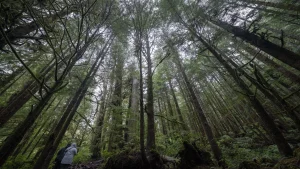
Despite receiving thousands of letters and submissions protesting the logging, one of these approvals was given to Teal Jones to log millennia-old yellow cedars near the ridge of Fairy Creek, fragmenting one of the largest remaining unprotected old-growth forests on southern Vancouver Island.
The other approval on Vancouver Island is the sale to West Coast Log Salvage Co. by B.C. Timber Sales (an agency within the Ministry of Forests) of a former “priority deferral” area on Tsitika Mountain.
This area runs down to the world-famous Orca rubbing beaches near Telegraph Cove. The proposed cut block, most of which is classified as “ancient” (more than 400 years old), abuts the Tsitika Ecological Reserve and provides nesting habitat for at least 300 endangered marbled murrelets.
Yet another 100 cutblocks are scheduled for the South Coast. These include a watershed identified as a water recharge area for Gibsons, nine in old-growth deferral areas, and 10 in old-growth management areas. Two are in the Theodosia watershed, where the B.C. government and the Tla’amin Nation just signed a memorandum of understanding committing to shared decision-making and salmon restoration.
B.C.’s River Forecast Centre charts Vancouver Island at less than 44% snowpack, and the South Coast is showing spring and summer drought conditions at 57%.
Water is not the only element the B.C. government is throwing under the bus, logging these forests. Because B.C. has no Species at Risk Act, logging these areas will destroy critical habitat for endangered birds, plants and other wildlife needing protection from extinction.
Wolves, bears, and the bees we need for pollination are also dependent on these forests for their lives.
Meanwhile, those who protest the cutting risk criminal contempt charges, which recently occurred for 10 people protesting last year in the Walbran.
A private forest company, Tsawak-qin Forestry Limited Partnership, influenced the attorney general to change their convictions from a civil charge to a criminal charge.
The “criminal” element means these people have their personal futures severely impaired because they believed that leaving these forests standing was in the public interest. However, the court deemed that the prosecution was in the public interest (the terms of a criminal charge). Who is acting in the public interest?
The science is clear that cutting old-growth forests is unsustainable. A new report based on scientific measures taken near the Port Renfrew area puts both the economic and ecological science succinctly.
The report’s author, Cedar Morton, said, “Old-growth forests quietly perform important services we rely upon that cannot be replaced once lost. When only timber value is counted, we systematically undervalue the living systems that sustain us. When we expanded the accounting beyond timber to include carbon storage, recreation and tourism, non-timber forest products, and education and research, the results revealed that even in an area with an active forest industry, keeping old-growth forests standing produced greater overall economic benefits than logging them.”
Ten years of taxpayer-funded government reports, as tall as Big Lonely Doug near Port Renfrew, conclude the same thing. The province’s Old Growth Strategic Review’s foresters conclude, “Had previous old forest strategies and recommendations been fully implemented, we would likely not be facing the challenges around old growth to the extent we are today, i.e., high risk to loss of biodiversity in many ecosystems, risk to potential economic benefits due to uncertainty and conflict, and widespread lack of confidence in the system of managing forests.”
The B.C. government should use these reports to act now, rather than hide behind them. We must stop all old-growth logging in the province and move to value-added forestry practices.
If we are short-sighted and do not protect nature, we risk huge economic burdens and ecological consequences: The destruction of watersheds and clean water, erosion of land and roads, fires, loss of a tourism and recreational economy, and many lives.
We must act now to protect the planet’s ecosystems, especially B.C.’s forests, which are the foundation of our economy.