Maude Barlow SPEAKING NOTES FOR THE CANADIAN ENVIRONMENT AWARDS
June 2, 2008
It is an enormous honour to stand before you tonight to receive this award and I thank Canadian Geographic and all of the other sponsors for it from the bottom of my heart. I am especially honoured to share this award with former recipients such as David Suzuki, Sheila Watt-Cloutier and Robert Bateman, all heroes and role models for me. It is important for me to say right away that I accept this award only on the understanding that it really belongs to a movement of ?justice warriors? here in Canada and around the world and it is in their name that I receive this tribute. I also want to congratulate my fellow award winners here tonight. You represent the best in our country.
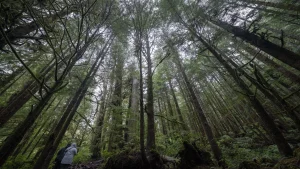
I also wish to take a moment to support the protest outside these doors. (My husband says I am the only person he knows who would help organize a protest at her own award.) For three years, the Council of Canadians has joined the Iskut and Tahltan First Nations, Skeena Watershed Conservation Coalition, ForestEthics, Sierra Club, Pembina Institute, Greenpeace, and the Dogwood Initiative in the campaign to save the sacred headwaters of the Nass, Skeena and Stikene Rivers in Northern B.C. from a coal bed methane mining operation by Royal Dutch Shell. It is here that three of British Columbia?s greatest salmon rivers find their source and where grizzly, caribou and stone sheep still roam free. Royal Dutch Shell plans to extract coal bed methane gas from the area?s anthracite deposits across an enormous area of one million acres, using a highly invasive mining procedure that leaves behind a legacy of toxic water. Commercial coal bed methane gas production has never before been attempted in salmon-bearing watersheds and local First Nations communities, local residents, and local salmon fishermen strongly oppose the project.
So do we at the Council of Canadians. And so I am proud to announce tonight that I will be giving my award money to the Sacred Headwaters Coalition and the First Nations in the area to support their fight to protect these pristine ancient fishing grounds in northern British Columbia. Your struggle is our struggle.
First Nations communities here in Canada and around the world often take the environmental brunt of petrochemical operations in their territories and it is crucial to support their right to determine when they do not want this kind of destructive energy extraction on their lands. Tonight in this room, there are other First Nations people who have been struggling against the poisonous fall-out of the petrochemical industry, in this case, residents of the infamous ?Chemical Alley? in Sarnia Ontario. Members of the Aamjiwnaang Environment Committee are here to honour Jim Brophy and Margaret Keith, not only for their tireless campaign against deadly asbestos mining and trading, but for Jim and Margaret?s support in their own struggle. Almost half of Canada?s chemicals are produced near the homeland of the Aamjiwnaang First Nation, and they have suffered greatly, with a documented skewed birth ratio of newborn girls outnumbering boys by two to one. Now Shell wants to build a new refinery in Sarnia to process oil extracted from the Alberta tar sands, where every barrel of oil produced creates three times as much greenhouse gas pollution as conventional oil, and three to five barrels of poisoned water. Surely it is time to put a halt to this destructive cycle of intensive energy production in this country and listen to the wisdom of our First Peoples who can teach us once again what it means to live with the land, water and air around us instead of off them.
The story repeats itself when we look at the global water crisis. While the crisis will eventually hit everyone, right now, it is killing the most vulnerable among us, mostly in the global South ? children, the old, indigenous peoples, peasants, urban slum dwellers. More children die every day of water borne disease than of AIDS, traffic accidents and war put together, in every case unnecessarily. In every case, if their parents had money, they could provide water for their children. But access to water is increasingly controlled by a global for-profit corporate water cartel. Corporations deliver drinking water and take away wastewater; corporations put massive amounts of water in plastic and sell it back to us at exorbitant prices; corporations are building sophisticated new technologies to recycle our dirty water and sell that back to us at exorbitant prices; corporations move water by massive pipelines from watersheds and aquifers to sell it to big cities and industries; and corporations buy, store and trade water on the open market like running shoes.
While there is of course a role for the private sector in dealing with our water crisis (as there is in more sustainable energy production), corporate control of our water resources would have terrible ramifications for us all. If corporations control water, there will be little incentive to conserve because there is no money to be made in conservation. If corporations control water, only the rich will be able to afford it. If corporations control water, nature will have to fend for itself. If water in the future will only be accessible to those who can pay for it, who will buy it for nature?
The story is the same when we are faced with the travesty of the current global food crisis. Even the Globe and Mail?s Report On Business, usually a free market devotee, admitted last week that massive pools of pension and other investment funds have overheated the commodities market and are ?wreaking havoc? on food prices around the world, a development that could have ?catastrophic effects? on Northern consumers and ?starvation? for the world?s poor. The Globe links this crisis back to the deregulation of commodities under Ronald Reagan, who allowed large speculators to trade and control for their profit virtually unlimited amounts of corn, wheat and other food staples. Corporate control of food production is deregulation?s evil twin. The World Bank and the World Trade Organization have adopted a policy of what Walden Bello of Focus on the Global South calls ?de-peasantization? ? the deliberate phasing out of a model of local and sustainable rural food production to make the countryside a more congenial site for intensive capital accumulation by a handful of giant agribusiness transnationals eager to serve the global supermarket. Indian social justice leader Vandana Shiva says reducing farmers to mere consumers of corporate controlled seeds and the chemicals that allow them to grow, has unleashed an epidemic of farmer suicides, over 150,000 in India alone over the last decade.
We stand at a perilous moment. Mother earth is heating up; our glaciers melting; our rivers running dry; we are on the brink of the 6th great species extinction. Everyone I know knows this, and millions of engaged citizens around the world are working as hard as they can to save our planet and our selves. Why are we not making more headway? In his brilliant new book, How the Rich are Destroying the Earth, Herv? Kempf says that we cannot combat the expanding ecological crisis because it is intimately linked to the social crisis in which the ruling form of capitalism has been organized to impede democratic initiatives. The failure to make progress against the greatest emergency of our time lies at the feet of the global royal class of political and business leaders, economists and elite journalists who refuse to abandon their blind allegiance to the destructive narrative of economic globalization, unfettered head to head nation state competition, export expansion and unlimited growth, when every indicator we have tells us this narrative is killing the planet. As American environmentalist Edward Abbey said, ?Growth for the sake of growth is the ideology of the cancer cell.?
A major report from CIBC World Markets last week warned that, because of skyrocketing energy prices, the party is truly over. Marine shipping rates jumped 72 percent in the last year. Unless that cargo container ship is filled with diamonds, says CIBC, think again whether we can any longer import what could be grown or processed locally, adding that it appears ?globalization is reversible.? But try telling that to our leaders here in Canada, where we continue to make policy based on the old promise of unlimited growth, committing more of our resources to U.S. trade expansion instead of powering down our continental energy use, and expanding ports, highway corridors and liquid nitrogen gas terminals to facilitate growing imports of Asian goods into the American heartland. This is bad policy ? environmentally, socially and even economically, given that we are running out of the essentials that keep the global markets treadmill spinning – and counter to the policies of local sustainable food production, local stewardship of resources, and watershed restoration that are the true answer in the end.
Nor has our government taken measures to protect our water supplies from commercial export. Last spring, senior government officials from Canada and the United States met in Calgary to discuss a new arrangement for sharing continental water supplies. The meeting was organized by an American think-tank, the Center for Strategic and International Studies that is also advising the Bush administration and the Pentagon on the national security implications of water scarcity in the U.S. Also in the consortium advising the White House are big water technology companies such as Proctor & Gamble, bottling giants such as Coca Cola, and Lockheed Martin, the world?s biggest weapons manufacturer, proof that he U.S. is taking the threat of water shortages very seriously. Yet our government continues not only to refuse to protect our water resources from such hungry eyes, it refuses to recognize the human right to water at the United Nations, shaming all Canadians in the international arena. This is because agreeing that water is a right would contradict the definition of water as a tradable good in NAFTA and close off commercial sale of our water in the future, something our political and corporate elite refuse to do. Successive Canadian governments have exposed Canada?s energy security to the insatiable appetite to the South of us; now the Harper government is exposing our water security for potential commercial gain.