Brennan Clarke JUL 3, 2009
To help map out the future, TimberWest installed real estate guru Bob Rennie as Couverdon?s head of marketing in February. In addition to his marketing savvy, Rennie brings extensive experience in navigating government regulatory channels, a key component of the Couverdon mission. (?A lot of Bob?s behind-the-scenes work in the last four or five years has been dealing with government in getting that Woodward?s building done,? Bruyneel explains.) And while Rennie is perhaps best known for his work on high-end condo developments such as Vancouver?s Shangri-La and Millennium Water, he maintains that this is not the kind of development Vancouver Island needs. ?None of Couverdon?s dialogue is about urban luxury,? he says. ?I?m a very opportunistic person, but the market is just not there for it. Everybody wants yesterday back and it?s gone.?
Couverdon?s primary target market will be baby boomers from the Prairies who want to retire to Vancouver Island but can?t afford a million-dollar home, explains Rennie.
The economic downturn, he adds, has eaten away at the retirement investments of people in that demographic and forced many of them to scale back their retirement plans. ?I envision an ad appearing in 18 months in the Calgary Herald and the Edmonton Journal saying, ?This is what you really want to buy on Vancouver Island,?? Rennie says. Affordability in the new market will mean smaller lots and compact homes, with a mix of single-family dwellings, townhouses, ?brownstones? and even manufactured home parks blended together in planned communities. ?We have to identify product that will sell today,? he says. ?We can do affordability with a view.?
In the past, Rennie says, developers built what they wanted and paid minimal attention to their neighbours. The future, he says, is all about ?social engineering,? using modern planning concepts to develop sustainable neighbourhoods that address community needs such as affordable housing. ?We recognize that whatever happens, we?re going to wear it, and that?s why we?re taking this long-term approach,? Rennie says. Couverdon is crucial to TimberWest?s long-term financial survival, he adds. ?It?s saying, How can we sustain the mother ship and still be part of the community?? Rennie says. ?Municipalities need to increase their tax base and we?re their neighbour.?
Couverdon?s ultimate goal in Ladysmith is to have its land, now in the Regional District of Nanaimo, absorbed into the town boundaries in return for zoning designations that would increase the property?s market value and pave the way for future development. ?We can help them meet their growth vision by annexing some of that land into their municipality,? explains Bruyneel. ?But before the annexation, we need to have some expectations regarding the land use and the zoning.?
For Ladysmith Mayor Rob Hutchins, the idea is both enticing and fraught with challenges. On the one hand, annexing the land would expand the town far beyond its urban containment boundary ? a move sure to alarm the anti-development crowd and raise concerns about the impact of roads, driveways and lawns on the forest ecosystem. On the other hand, it would increase the town?s tax base, reduce the amount of logging in the hills above town and offer an opportunity to protect Stocking Creek and Holland Creek, two crystal clear mountain streams that supply the town?s drinking water.
?If it?s going to be considered, we need protection of our watershed and protection of our view corridors,? says Hutchins, echoing concerns voiced at a public ?visioning session? on the idea last summer. With about 8,100 people at last count, Lady?smith?s population has grown by more than 70 per cent since 1991. While there?s still a significant amount of land available for development within the municipality, Hutchins admits Couverdon?s proposal would give the town substantial control in planning for future growth. ?There?s tremendous potential for the new sustainable community development concepts,? he says.
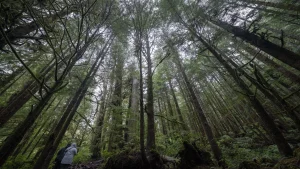
Of all the areas earmarked for future development, the one that?s generated the most controversy is Nanaimo Lakes, where TimberWest promises any potential projects are ?five to 10 years? down the road. A half-hour drive from Nanaimo, the wilderness area is a popular recreational playground for city residents, who for decades have enjoyed its pristine hunting, fishing, boating and hiking opportunities, with the landowner?s tacit approval. But in recent years, TimberWest has raised the ire of outdoors enthusiasts by locking the gates that provide access to almost 30,000 hectares of land in the area. TimberWest?s Bev Park defends the closures, saying the company was forced to restrict public access after the Kelowna forest fires of 2003 sent insurance costs on timberland into the stratosphere.
Local residents are skeptical. ?In the last few years, their approach to access has been more restrictive,? says Doug Janz, a director with the Nanaimo Fish and Game Club. ?They?ve cited liability concerns, but it?s pretty clear they just don?t want people behind the gates.? While TimberWest has made vague references to combining resort, recreational and residential uses at Nanaimo Lakes, its plans have yet to progress beyond the ideas stage. Bruyneel says only a fraction of the area yet to be determined is slated for development.
Still, the very thought of resort hotels, upscale fishing lodges and lakeside cottages in the area has generated plenty of community concern. ?Not a day goes by that I don?t get a call about it,? says Regional District of Nanaimo chair Joe Stanhope. ?We keep hearing they?re going to do this, they?re going to do that, and my residents go crazy. They say, ?You?re going to allow development of our forests.? ? The idea of building houses on land so far from an urban centre goes against the regional district?s policy of limiting rural sprawl, he says. But the biggest fear is the potential effect on the region?s water supply, which is fed by aquifers running beneath TimberWest?s Nanaimo Lakes land. ?It?s worrisome to us, but it?s really worrisome to residents,? Stanhope says.
While development at Nanaimo Lakes is a ways off, other TimberWest projects are much closer to becoming reality. There?s the proposed Jubilee Heights development in Campbell River, a 120-hectare chunk of forest at the south end of town slated for a 1,300-unit ?live-work? neighbourhood with affordable housing, recreation opportunities and land for a school. TimberWest has also taken significant strides toward redeveloping 166 hectares of land near Campbell River Airport, which, thanks to a complicated land swap with the province?s Agricultural Land Commission, is being rezoned for industrial use. Another effort to subdivide reserved agricultural land, however, proved more problematic: after a series of public meetings over the winter, the company withdrew its application to carve a 166-hectare patch of former forestland near Dove Creek into 11 ?small lot? farms. Bruyneel admits that a negative community reaction forced the company back to the drawing board, observing somewhat diplomatically, ?We?re re-evaluating our proposal based on the feedback we received.?
Couverdon?s progress will be measured by the extent to which B.C.?s forest industry can recover and generate profits from timber harvesting that exceed the revenue potential of real estate development. While TimberWest maintains a firm commitment to logging the other 83 per cent of its vast timber holdings, Park acknowledges the forestry side of the business is a shadow of its former self. In the late 1990s, she notes, the company employed 1,400 people. A decade later, mill closures, downsizing and economic turmoil have reduced TimberWest?s workforce to just 88 full-time employees, including a dozen under the umbrella of Couverdon. Tree harvesting, now handled by independent contractors, indirectly employs another 600 people.
Is Couverdon a sign of the demise of B.C.?s forest industry? Probably not. But it does mark the beginning of a new era in which loggers will inevitably find themselves rubbing shoulders with real estate agents and developers. Whether they support the change or not, at least TimberWest?s neighbours will have the chance, through prolonged and detailed public input, to shape the future of their communities.
But as the future unfolds, residents of scenic Vancouver Island resource towns will have to ask themselves what kind of economy they want. Should it be powered by the heavy-duty engine of timber harvesting and all its spin-offs, or propped up by inflated property values and a dependence on the disposable income of wealthy outsiders who come to enjoy the Vancouver Island lifestyle?
No doubt some will conclude their very survival depends on finding a delicate balance somewhere between the two.
http://www.bcbusiness.ca/natural-resources/beyond-the-woods-timberwest-and-real-estate?page=2